Source high power led work light for Trucks, Construction, Mining
Explore 30 verified options for high power led work light designed for trucks, construction sites, and mining operations. Compare specifications including power ratings from 6W to 30W, waterproof ratings, and certifications like CCC and RoHS to find the right fit for your needs.
Key considerations
Products List




Comprehensive Sourcing Guide
Strategic Sourcing Guide for High Power LED Work Lights
Understanding Technical Specifications and Performance Metrics
When sourcing high power LED work lights, the primary objective is to align technical specifications with the rigorous demands of industrial and commercial environments. The product landscape for these lights is defined by specific power ranges, voltage requirements, and optical characteristics. Based on current market observations, high power LED work lights typically operate within a power spectrum ranging from 6 to 30 watts. This broad range allows buyers to select units that match specific illumination needs, from general utility tasks requiring 6-10 watts to heavy-duty commercial applications demanding 16-20 watts or even 21-30 watts.
Voltage compatibility is a critical technical factor. Most high power LED work lights in this category operate on 12V DC systems, which is standard for automotive and off-road applications, while others are designed for AC voltage types suitable for fixed industrial installations. The emitting color and color temperature are equally vital for operational safety and visibility. Buyers will encounter units offering pure white light, which is standard for general and commercial applications, as well as warm white options for specific atmospheric requirements. Furthermore, advanced models feature changeable emitting colors or dual-color outputs, such as white and amber combinations, providing versatility for signaling and warning scenarios.
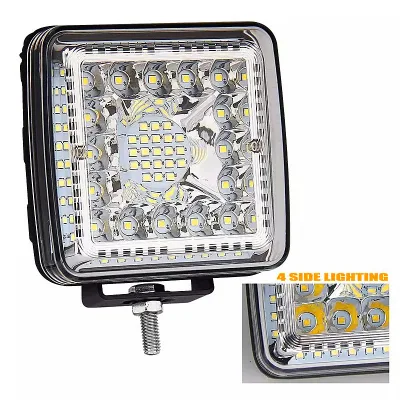
The physical construction of these lights also dictates their performance. A common form factor observed in the market is a square design with dimensions of 110mm by 110mm, though other sizes exist. The lens material is typically clear glass, ensuring maximum light transmission. Crucially, the IP rating, often cited in conjunction with LED chip brands like Bridgelux or CREE, determines the light's resistance to environmental elements. Waterproofing is a non-negotiable attribute for work lights used outdoors or in harsh conditions. Buyers must verify that the specific model selected meets the necessary ingress protection standards to prevent water and dust ingress, which can lead to premature failure.
Compliance and Certification Verification
Navigating the compliance landscape is essential for ensuring that high power LED work lights meet safety regulations in target markets. The certification requirements vary significantly depending on the region of operation. A comprehensive list of certifications observed in the market includes CCC (China Compulsory Certification), E-mark (for European vehicle markets), SONCAP (for Nigeria), and PVOC (for Saudi Arabia). These certifications indicate that the product has undergone specific testing protocols relevant to its intended region.
For international trade, particularly in North America and Europe, additional certifications are often required. Buyers should look for products bearing RoHS (Restriction of Hazardous Substances) compliance, which ensures the absence of specific hazardous materials. In the United States, certifications such as CE, C-tick (Australian), ETL, and UL are critical. The UL standard, specifically UL 8750 for lighting products, is a benchmark for safety, though buyers must verify if a specific product explicitly claims this standard rather than assuming it applies to all listings. The presence of multiple certifications, such as CREE, CE, C-tick, ETL, RoHS, and UL on a single product, suggests a higher level of quality control and market readiness.
It is important to note that certification status is not universal across all listed products. Some items may carry only a subset of these certifications. Therefore, procurement teams must cross-reference the specific model number with the required regulatory framework of the destination country. Relying on a product that lacks the necessary local certification can lead to customs delays, legal liabilities, or safety hazards. The "Export Standard" is a general designation found in product descriptions, but it should not be confused with specific national or international safety marks. Buyers must demand proof of certification for the specific batch being purchased to ensure full compliance.
Cost Drivers and Pricing Structures
The pricing of high power LED work lights is influenced by a complex interplay of factors, including power output, certification breadth, and packaging requirements. The observed market price range for these products spans from $1.50 to $250.00 USD. This wide disparity reflects the diversity in product quality, technology, and intended application. Lower-priced units typically fall within the 6-10 watt range and may lack extensive international certifications, making them suitable for cost-sensitive, low-risk applications. Conversely, the higher end of the price spectrum often corresponds to 21-30 watt units featuring premium LED chips, robust waterproofing, and a full suite of safety certifications like UL and ETL.
Minimum Order Quantity (MOQ) is another significant cost driver. The market observes an MOQ range between 10 and 2,000 units. Smaller MOQs, such as 10 or 100 pieces, allow for lower initial capital expenditure but may result in a higher unit cost due to the lack of economies of scale. Larger orders, often required for 2,000 units, can significantly reduce the per-unit price but require substantial upfront investment and storage capacity. Buyers must balance their budget constraints with their inventory needs. Additionally, the packaging type influences the final cost. Products shipped in simple boxes or cartons are generally less expensive than those requiring custom color boxes or specialized protective packaging, which adds material and labor costs.
Typical Applications and Use Cases
High power LED work lights are versatile tools designed for a wide array of applications, primarily categorized into general, commercial, and specialized industrial uses. The "General" application category covers broad usage scenarios such as vehicle auxiliary lighting, temporary site lighting, and residential outdoor illumination. These lights often feature pure white emitting colors and operate at lower power levels (6-10W) to provide sufficient visibility without excessive energy consumption.
The "Commercial" application sector demands higher performance and durability. Lights in this category frequently utilize higher power outputs (16-20W or 21-30W) and may include advanced features like changeable colors or dual-color outputs (white + amber) for signaling purposes. These units are commonly deployed in construction sites, mining operations, emergency response vehicles, and port facilities. The requirement for waterproofing and high IP ratings is most stringent in these environments, where exposure to rain, dust, and vibration is constant.
Specific model numbers often indicate their intended use. For instance, models like JP-141 or FC-422 are frequently associated with commercial-grade applications, while others like DX001B or TK5045EM may serve general or specialized roles. The choice of application dictates the necessary technical specifications. A buyer sourcing lights for a fleet of delivery trucks will prioritize 12V compatibility and compact dimensions (110x110mm), whereas a buyer for a construction site might prioritize high wattage and rugged packaging standards.
Supplier Evaluation and Sourcing Criteria
Evaluating suppliers for high power LED work lights requires a focus on transparency, consistency, and logistical capability. The product origin is consistently listed as China, which is a major manufacturing hub for LED lighting. However, the origin alone does not guarantee quality. Buyers should prioritize suppliers who provide clear documentation regarding their production standards and quality control processes. The "Export Standard" is a common claim, but it is more valuable to verify if the supplier adheres to specific international quality management systems.
Packaging standards are a key indicator of a supplier's professionalism. Observations show that products are packed in various formats, including standard boxes, color boxes, white boxes, and cartons with specific quantities per carton (e.g., 40pcs, 50pcs, 100pcs). A supplier who maintains consistent packaging standards, such as "50PCS ONE CARTON" or "100pcs one carton," demonstrates a structured logistics operation. This consistency is crucial for inventory management and shipping efficiency.
Furthermore, the availability of customization is a significant differentiator. Many suppliers offer customization options, allowing buyers to tailor product specifications, branding, or packaging to their specific needs. This flexibility is particularly valuable for large-scale procurement where branding and specific technical requirements are paramount. Buyers should assess the supplier's ability to handle custom orders without compromising on quality or lead times. The MOQ flexibility, ranging from 10 to 2,000 units, also indicates the supplier's capacity to accommodate both small trial orders and large volume contracts.
Quality Control and Long-Term Procurement Considerations
Ensuring long-term reliability requires a robust quality control strategy. The durability of high power LED work lights is heavily dependent on the quality of the LED chips, the driver circuitry, and the sealing of the housing. Brands like Bridgelux and CREE are frequently mentioned in relation to LED chip quality, suggesting that these components are a benchmark for performance. Buyers should verify that the specific units they purchase utilize these or equivalent high-quality chips to ensure longevity and consistent light output.
The IP rating is another critical quality metric. While "Waterproof" is a general attribute, the specific IP rating (e.g., IP65, IP67) must be verified for the intended environment. A lack of specific IP data in a product listing should prompt a request for detailed test reports. Additionally, the color temperature consistency is important; units labeled as "Pure White" or "Warm White" should maintain their color characteristics over time without significant degradation.
Long-term procurement considerations also involve the supply chain's stability. Suppliers offering a wide range of models, from DX001B to TK4618LSB, provide a buffer against supply disruptions. If a specific model becomes unavailable, a supplier with a diverse portfolio can offer alternatives that meet the same technical criteria. Buyers should also consider the warranty terms and after-sales support, as high power LED work lights are subject to wear and tear. Establishing a relationship with a supplier who can provide consistent quality and responsive support is essential for maintaining operational continuity.
Comparative Analysis of Key Product Attributes
To facilitate informed decision-making, the following table summarizes key attributes observed across the high power LED work light market. This comparison highlights the diversity in specifications and helps buyers identify the right product for their specific needs.
| Attribute Category | Common Observations | Variations & Notes |
|---|---|---|
| Power Output | 6-10W, 11-15W, 16-20W, 21-30W | Higher wattage correlates with commercial use and higher cost. |
| Voltage | 12V DC, AC | 12V is standard for vehicle applications; AC for fixed installations. |
| Certifications | CCC, E-mark, RoHS, UL, CE, ETL | Regional requirements vary; verify specific market compliance. |
| IP Rating | Waterproof (General) | Specific IP numbers (e.g., IP67) must be confirmed for harsh environments. |
| Dimensions | 110*110mm | Other sizes exist; verify fitment for specific mounting locations. |
| Packaging | Box, Carton, Color Box, White Box | Quantities per carton vary (40, 50, 100 pcs); affects shipping cost. |
| MOQ | 10 - 2,000 Units | Lower MOQ for testing; higher MOQ for volume discounts. |
| Origin | China | Standard manufacturing hub; verify factory audits for quality. |
This table serves as a reference point for buyers to quickly assess the breadth of options available. It underscores the importance of matching specific technical requirements with the supplier's capabilities. By carefully analyzing these attributes, procurement teams can mitigate risks and ensure that the selected high power LED work lights deliver optimal performance and value.
FAQs
What certifications are available for high power led work light?
Available certifications include CCC, E-mark, SONCAP, PVOC, RoHS, CE, C-tick, ETL, and UL. Buyers must verify specific model compliance as not all units carry every mark, and some listings may only show a subset of these safety standards.
Which power ranges are offered for high power led work light?
Power outputs range from 6-10W up to 21-30W depending on the application. General tasks often use lower wattage, while commercial or heavy-duty needs require higher power units like those rated at 16-20W or 21-30W.
Can high power led work light be customized for specific needs?
Customization is available for many models to meet specific buyer requirements. This flexibility allows for tailored specifications, branding, or packaging options to suit unique procurement needs without compromising on the core product functionality.
What is the typical MOQ for high power led work light?
Minimum Order Quantities range from 10 to 2000 units depending on the supplier and model. Smaller orders allow for lower initial investment, while larger volumes often secure better per-unit pricing and economies of scale.
Where are high power led work light products manufactured?
Products originate from China, which is a major manufacturing hub for LED lighting. Buyers should verify the specific origin and export standards for each batch to ensure compliance with destination country regulations.
How are high power led work light products packaged for shipping?
Packaging options include Box, Carton, Color Box, and White Box formats. Carton quantities vary, with standards like 40, 50, or 100 pieces per carton, ensuring structured logistics for inventory management and efficient shipping.